
How old is the average European? How much do we drink and smoke? And what is the influence of climate change?
I went through the statistics and found some surprising answers. Here are five facts about Europe — and Europeans — that you might not know.
And then there is one more claim I couldn’t resist checking: is it really true that one in ten Europeans was conceived in an IKEA bed?
1. Europe has the oldest population in the world
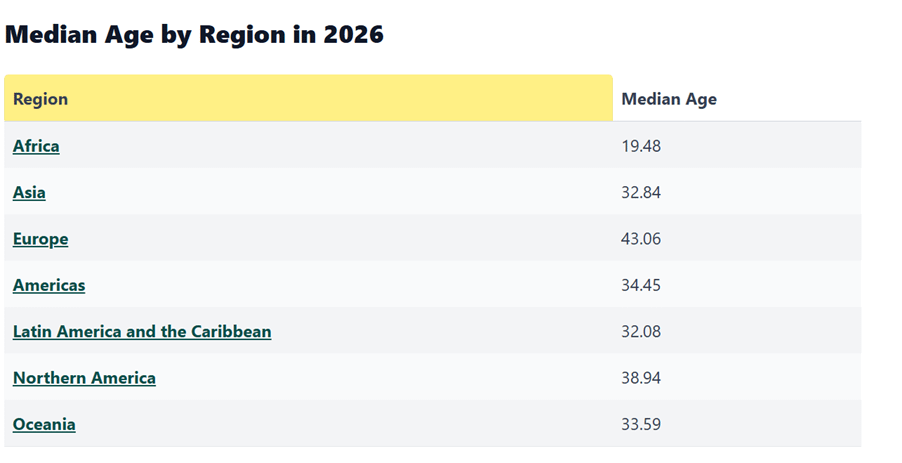
Europe is getting older — and, on average, greyer. I am not talking about the weather in northern Europe or a particular art movement, but about the age, and therefore perhaps the hair colour, of the average European.
According to UN population data, Europe has the highest median age of any world region. And the trend is unmistakable: Europe is ageing rapidly.
Source: Global Median Age 1950-2026 & Future Projections | database.earth
If we zoom in on the European Union, Eurostat reports that the median age reached 44.9 years in 2025. In other words, half of the EU population was older than 44.9, while the other half was younger. The highest median age was recorded in Italy, at 49.1 years, followed by Bulgaria and Portugal at 47.3 years. At the other end of the scale were Ireland (39.6), Luxembourg (39.8) and Malta (40.0).
Europe is not only getting older; its population is also shrinking naturally. In the EU, deaths have outnumbered births since 2012. In 2024, the crude rate of natural population change was -2.8 per 1,000 inhabitants. Latvia (-7.4) and Bulgaria (-7.3) recorded the steepest declines, while Ireland (+3.4), Cyprus (+3.1) and Luxembourg (+2.9) were among the few countries where births still clearly outnumbered deaths.
So what can Europe do about its rapidly ageing population? Who will look after our healthcare systems, industries and welfare states in the decades to come?
One possible answer is migration — although in many European countries, that remains one of the most politically sensitive subjects.
On 1 January 2025, almost 10% of the EU population — around 45 million people — were citizens of a country other than the country in which they lived. Around 14 million were citizens of another EU member state, while approximately 31 million were citizens of a non-EU country.
2. Europe is the world’s most visited tourism region
Europe is famous for its history — its castles, museums and ancient cities — and for its culture, food and wine. Apparently, the rest of the world has noticed too.
Europe is the world’s largest tourism destination region. In 2024, it welcomed roughly 747 million international tourist arrivals, more than any other region in the world. The EU had almost 530 million international arrivals.

Source: Tourism trends, performance and outlook: OECD Tourism Trends and Policies 2026 | OECD
France remains the world’s most visited country. In 2025, it received around 102 million international arrivals, followed by Spain with 96.8 million and Italy with 61.3 million. The United States, by comparison, received around 68.2 million- a drop of 14 per cent compared to the year before.
And it is not only the major European powers that attract visitors. The Netherlands, for example, received more than 22 million international visitors.
There is something remarkable about that. Europe accounts for roughly half of all international tourist arrivals worldwide. A continent that represents only a fraction of the world’s landmass has become the planet’s greatest tourism magnet.
3. Europeans are the world’s biggest tobacco users
Europe has made progress in reducing smoking and tobacco use — but not enough.
According to the World Health Organization, Europe has the highest prevalence of tobacco use in the world. In 2000, more than one in three adults in the region used tobacco. By 2024, that had fallen to 24.1%, or around 173 million people.
Among men, tobacco use fell from almost 50% in 2000 to 30.8% in 2024. Among women, however, the decline has been much slower: from 22.3% to 17.4%.
And just when you thought people were quitting, there is another nicotine product to consider: the e-cigarette. The WHO estimates that 4.6% of adults use e-cigarettes, more than twice the global average. Among young people, the picture is even more worrying.
So while Europeans may be smoking less than they used to, the continent still holds an unfortunate world record when it comes to tobacco use.
4. Europeans drink the most alcohol in the world
A beer or a glass of wine on a sunny terrace at the weekend sounds appealing, right?
Perhaps a little too appealing.
According to the WHO, the European Region has the highest alcohol consumption per capita in the world. Adults consume an average of 9.2 litres of pure alcohol per year. These figures are based on the latest globally comparable data, from 2019.
The numbers behind the statistic are striking. Around two-thirds of adults in the region consumed alcohol in the previous 12 months, and the WHO estimates that around 11% of adults live with an alcohol use disorder, while almost one in 20 live with alcohol dependence.
The EU is particularly prominent in this ranking. Seven of the ten countries with the highest per-capita alcohol consumption in the world are EU member states.
I repeat: seven out of ten, in the world.
So perhaps that next drink on the terrace is worth thinking about twice.
5. Europe is the fastest-warming continent in the world
While you are enjoying that drink in the sunshine, there is another — rather less cheerful — European record to consider.
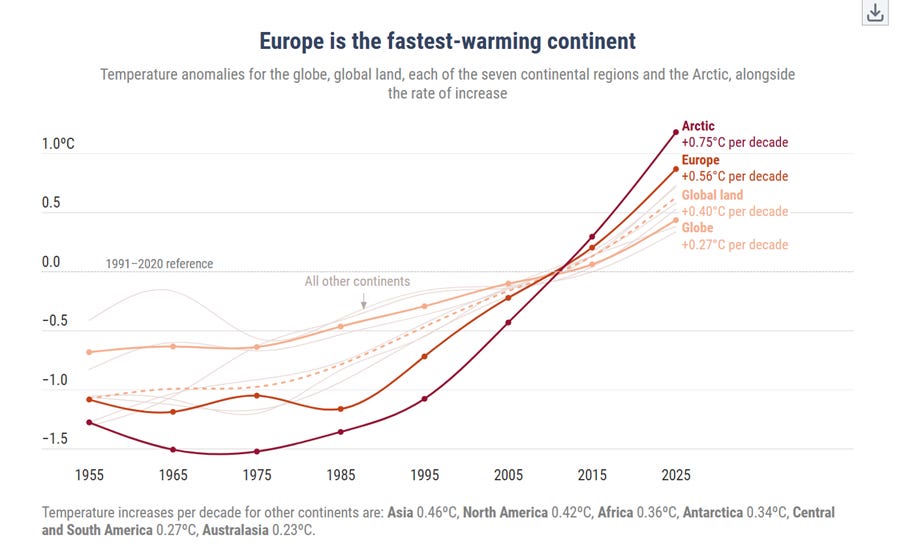
Europe is the fastest-warming continent in the world.
Source: 1. Why is Europe warming so quickly? | Copernicus
According to the Copernicus Climate Change Service, Europe is warming more than twice as fast as the global average. Between 1996 and 2025, temperatures in Europe increased by approximately 0.56°C per decade, compared with around 0.27°C per decade globally.
The consequences are already visible: more frequent and intense heatwaves with more intense summers, changing rainfall patterns, melting glaciers and growing pressure on ecosystems and societies.
So Europe may be a particularly attractive place to visit — but the climate is changing faster here than almost anywhere else on Earth.
6. One in ten Europeans was supposedly conceived in an IKEA bed
Alright, a last one — although it comes with a big asterisk as it is most probably not true. This one is the myth.
I first came across the claim in a book by the German philosopher Peter Sloterdijk, The Continent Without Qualities: one in ten Europeans was supposedly conceived in an IKEA bed.
It sounds like exactly the kind of statistic that is too good to be true.
And unfortunately, it probably is.
The claim can be traced back at least to a 2004 article in The Guardian, which stated that it had been “calculated” that 10% of Europeans alive at the time had been conceived in an IKEA bed. But the article provided no study, survey or methodology to support the figure.
The claim was subsequently repeated by other media outlets and eventually became part of IKEA’s own mythology. But no credible research has ever established that exactly one in ten Europeans was conceived in an IKEA bed.
In other words: it is a great statistic, a memorable marketing story — and almost certainly not a real statistic.
Do you like this post? I write about Europe, politics, identity, independence and the numbers behind the continent. Subscribe if you’d like more.
Sources:
Demography of Europe – 2026 edition - Interactive publications - Eurostat
Duration of working life reached 37.5 years in 2025 - Actualités - Eurostat
Tourism trends, performance and outlook: OECD Tourism Trends and Policies 2026 | OECD
1. Why is Europe warming so quickly? | Copernicus
: IKEA | Design is For Everyone | The One Club
The miracle of Älmhult | Life and style | The Guardian
A note on terminology: For clarity, this blog uses several different definitions of “Europe”. Depending on the source, this can refer to the European Union or to a broader geographical or institutional region. The WHO, for example, refers to the “European Region”, which is broader than the EU and includes 53 countries.